I woke this morning to the carol, The First Noel ringing in my mind. No, it wasn’t playing on the radio, but I suspect it was the cumulative effect of our reflections. I thought about God choosing to first self-reveal to the shepherds. That took me once again to God’s marvellous and mystic ways. Just think, the Almighty God, Emperor of emperors, choosing to be born in the back room of someone’s home. This is the same God Who prepared widows to feed God’s prophets.
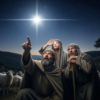
God could easily have commandeered someone to make room. It would have happened. In fact, God could have commandeered the shepherds, Anna, or Simeon to make room somewhere. God did not. Then, when God finally sent the angel to announce that the Emperor of emperors had been born, God chose… shepherds!
And, we’re told that God chose to offer proof that this was indeed The Emperor that they were anticipating. I suspect it was necessary, given the circumstances. But then, one must marvel at the two main items of proof – swaddling cloths and a food trough for animals. Siblings, there’s so much mysticism, rather mystery, in Luke’s birth narrative that we truly need to explore the significance of the signs. Consider Today’s Holy Nougat.
Luke 2:7-12, 16 AMP
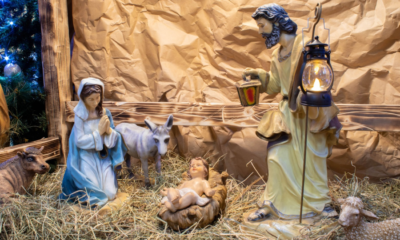
[7] and she gave birth to her Son, her firstborn; and she wrapped Him in [swaddling] cloths and laid Him in a manger, because there was no [private] room for them in the inn.
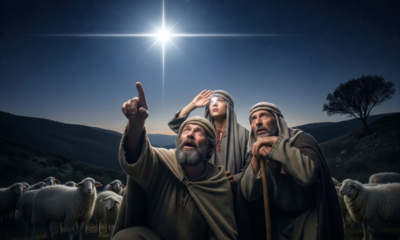
[8] In the same region, there were shepherds staying out in the fields, keeping watch over their flock by night.
[9] And an angel of the Lord suddenly stood before them, and the glory of the Lord flashed and shone around them, and they were terribly frightened.
[10] But the angel said to them, “Do not be afraid; for behold, I bring you good news of great joy which will be for all the people.
[11] For this day in the city of David, there has been born for you a Savior, who is Christ the Lord (the Messiah). [Micah 5:2]
[12] And this will be a sign for you [by which you will recognize Him]: you will find a Baby wrapped in [swaddling] cloths and lying in a manger.” [see 1 Samuel 2:34; 2 Kings 19:29; Isaiah 7:14]
[16] So they went in a hurry and found their way to Mary and Joseph, and the Baby as He lay in the manger.
Good News … With Proof 3
Just now, it struck me that I have always assumed that the shepherds were not necessarily spiritually literate. Their fear of the angel(s) is not proof that they didn’t know God or that they had not been attuned to the prophecies. What seems obscure to us could readily have been known to the shepherds, as the scripture references in the Amplified Bible suggest. They discussed, saw the proof, and noised it abroad that Jesus was truly the Messiah. The proof was valid to them.
Self-Check
What assumptions have we made about Christ’s birth, which might not necessarily be true?
Digging Deeper
Firstly, let me clarify a statement I made previously. The manger is mentioned at least thrice, not twice. It definitely was a significant sign to Theophilus, the lovers of God, to whom Luke wrote.
I also invite us to think about the fact that a manger is a feeding trough. The shepherds would have had first-hand knowledge of feeding troughs, they tended sheep. Some exegetes suggest that this pointed to Christ’s death, more so, the institution of the Lord’s Supper. That wouldn’t have necessarily been a sign for those shepherds, but definitely for those to whom the Gospel was addressed. But, the God Who provided signs to Gentile Magi, would have used the universal language of shepherds … food troughs and bandages.
Remember, the prophecies spoke of the Messiah being descended from David. David was a shepherd. David was ‘Their’ king. His descendant was one of ‘them’. Could it also be that they knew that Jesus was the Lamb of God? John used that term to describe Him in John 1:29, and it seems that John’s statement was not strange to that audience.
I’m also struck by the fact that Jesus lying in the manger bears a similarity to Abraham standing over Isaac. In that case, the manger was a sign for them then, and for us today. The shepherds ‘got’ it, do we?
Point to Ponder
What does the manger symbolise for us?
—
May all we seek be found in Christ